Five measurement failures. Five fixes you can verify.

Each file follows the signal to the broken layer, the bounded correction, and the acceptance test that closes it.

Worked examples, not customer case studies

Company profiles, systems, and data are composites built from recurring measurement patterns. They do not describe named Calyxra clients, completed engagements, testimonials, benchmarks, or realised results.

Start with the contradiction your team can see.

Incident file / 01Composite company · not a client

Reported Meta purchases moved immediately after a release. Shopify completed orders did not.

A checkout release made paid social look stronger overnight.

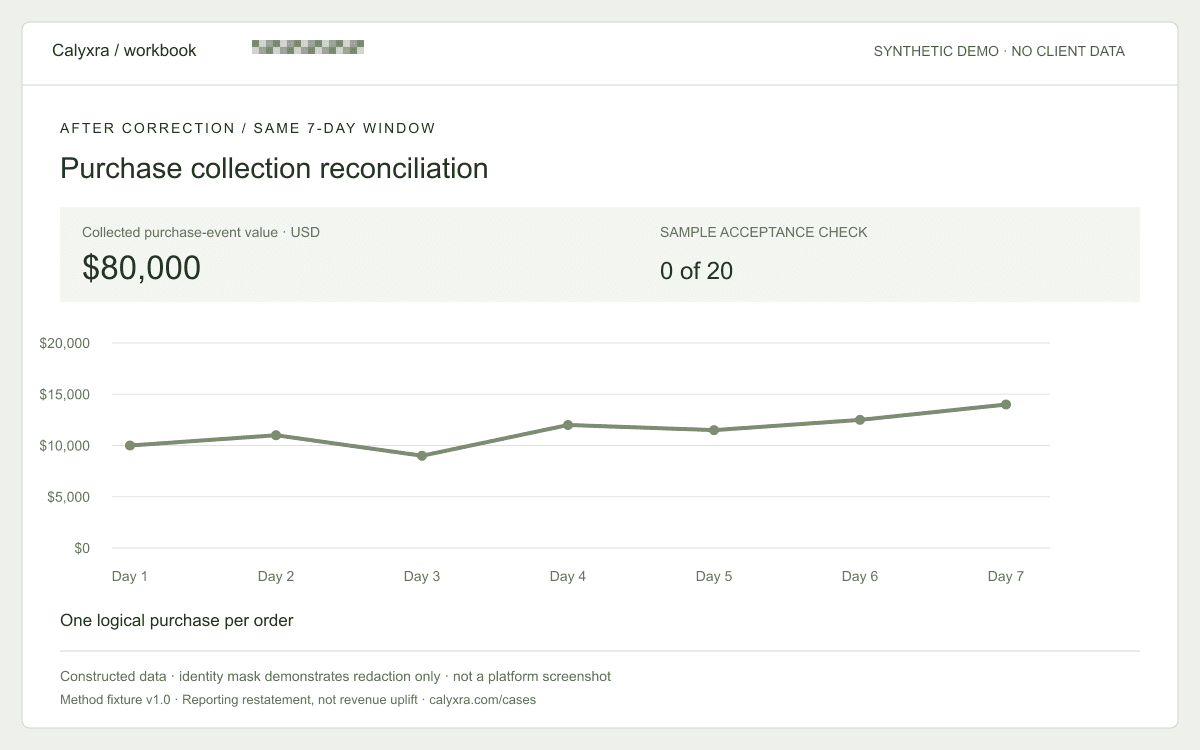
Acceptance stateOne logical purchase
Representative company profileConstructed for this worked example
BusinessPaid-social-led beauty brand
Market / modelUnited States · DTC
Relevant stackShopify Plus · Meta CAPI · consent platform
Decision ownerVP Growth + Ecommerce lead
Decision blocked

Did campaign performance improve, or did the new implementation count the same purchase twice?

Illustrative event trace / test order A-117Event identity

Before / mismatch

Browser purchaseID A-117
Server purchaseID B-204
Destination reads2 purchase recordsMismatch

After / corrected

Browser purchaseID A-117
Server purchaseID A-117
Destination reads1 logical purchasePass

A test-order trace illustrates collection integrity only. It is not a revenue or attribution result.

Cause isolated

Browser and server purchase paths used different event IDs, so one order could become two reported purchases.

Bounded change

Give both eligible event paths one deterministic order key and retire the obsolete duplicate trigger.

Acceptance check

A test order now produces one logical purchase with matching value, currency, and order reference.

Decision reopened

Observe a clean post-fix window before deciding whether paid-social spend should change.

What this does not prove

Meta-attributed conversions are not required to equal Shopify orders. Correct event collection improves reporting reliability; it does not create incremental revenue or causal proof.

Technical evidence & acceptance criteriaOpen working file +

Systems in view

  • Shopify Orders and Customer Events
  • Meta Pixel and Conversions API
  • Installed pixel app or tag manager
  • Consent platform

Evidence reproduced

  • Release timeline and affected reports
  • Consent-eligible test orders
  • Browser and server event payloads
  • Event IDs, order references, value, currency, and timestamps

Acceptance criteria

  • Each consent-eligible test order produces one logical purchase per destination.
  • Browser and server copies, where both remain, share the same event ID.
  • Value, currency, and order reference match the corresponding Shopify order.
  • Refreshing the confirmation page does not produce another purchase event.
  • Every exception in the agreed observation window is identified and explained.
Incident file / 02Composite company · not a client

Platform ROAS, an attribution tool, and Finance were using different definitions of revenue.

Growth said “scale.” Finance said “hold.” Both reports were consistent.

Acceptance stateMetric roles agreed
Representative company profileConstructed for this worked example
BusinessOmnichannel home-goods brand
Market / modelUnited Kingdom · DTC + retail
Relevant stackShopify · Meta / Google · attribution platform · Finance
Decision ownerCFO + Head of Growth
Decision blocked

Which number should control next week’s media budget?

Illustrative metric-role mapDefined roles ≠ forced equality
Paid platformsPacing signal

Attributed conversion value

Attribution modelDiagnostic

Channel credit under model rules

Finance contributionBudget guardrail

Realised commercial economics

Shared operating layerMetric contract

Source · formula · timing · refund lag · purpose · owner

Approved

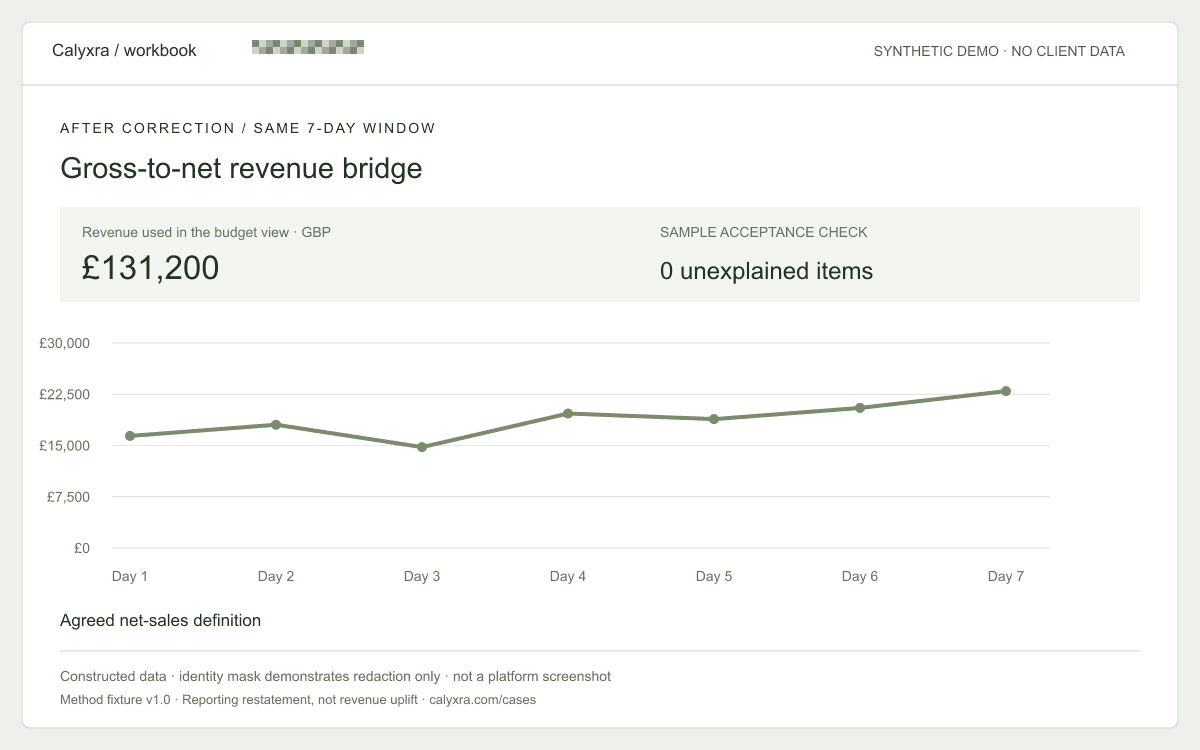
The resolution assigns each metric a job. It does not make attributed revenue equal company revenue.

Cause isolated

Three internally consistent reports answered three different questions, but no metric had a documented decision right.

Bounded change

Reconcile the eligible orders, label each metric’s role, and assign one Finance-grade budget guardrail.

Acceptance check

Sources, formulas, timing, refund lag, purpose, and owner are approved in one metric contract.

Decision reopened

Growth can pace channels without reopening the Finance definition at every budget meeting.

What this does not prove

Reconciliation does not prove channel incrementality. If the remaining question is causal, the handoff specifies the experiment required instead of inventing a causal ROAS number.

Technical evidence & acceptance criteriaOpen working file +

Systems in view

  • Shopify orders, discounts, cancellations, and refunds
  • Payment settlement or payout exports
  • Meta and Google Ads
  • Attribution platform and Finance model

Evidence reproduced

  • Eligible-order populations by report
  • Gross-to-net revenue bridge
  • Refund, cancellation, tax, fee, and currency treatment
  • Attribution windows, timezones, and metric formulas

Acceptance criteria

  • Growth and Finance use the same documented eligible-order population.
  • Remaining reconciliation variance is inside the agreed tolerance or tied to named timing and currency items.
  • No report presents overlapping channel-attributed revenue as additive company revenue.
  • Each controlling metric has a source, formula, timezone, refund lag, purpose, and owner.
  • The decision owners approve the metric contract in writing.
Incident file / 03Composite company · not a client

A reporting migration made returning buyers look new. Acquisition performance improved only in the dashboard.

New-customer CAC improved because customer history had been cut short.

Acceptance stateClassification corrected
Representative company profileConstructed for this worked example
BusinessRepeat-purchase apparel brand
Market / modelEuropean Union · DTC
Relevant stackShopify · warehouse · acquisition dashboard
Decision ownerAcquisition lead + Data lead
Decision blocked

Can the team trust new-customer CAC before moving more budget into prospecting?

Illustrative customer-history traceFirst eligible order

Before / recent extract only

Older orderNot loaded
Extract starts
Current orderObserved
ClassifiedNEW

After / complete available history

Earlier eligible orderObserved
Current orderObserved
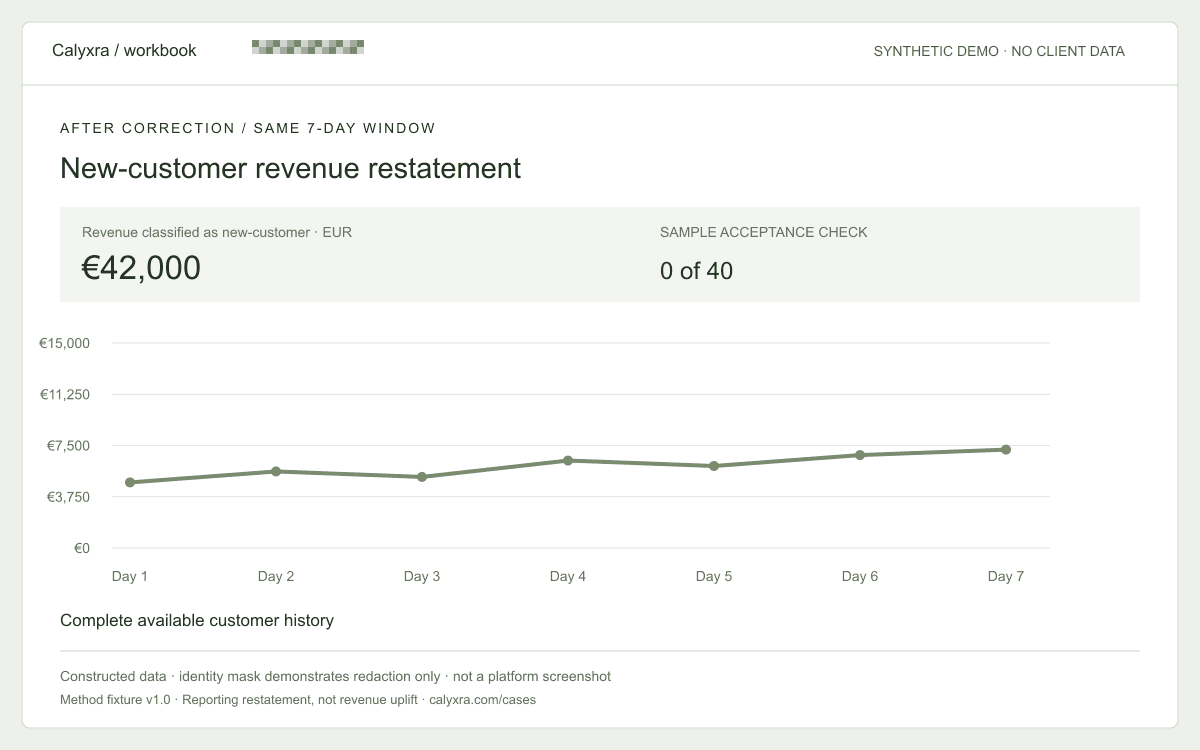
ClassifiedRETURNING

The correction repairs the reporting definition; it does not build a household identity graph.

Cause isolated

The migrated model searched only the recent extract, so buyers with older orders were incorrectly marked as new.

Bounded change

Rebuild first-order classification from the complete available history and version the customer definition.

Acceptance check

No sampled customer remains ‘new’ when an earlier eligible order exists, and each order is classified once.

Decision reopened

Reset the new-customer CAC guardrail before allocating more prospecting budget.

What this does not prove

This bounded correction does not build a household identity graph or prove the causal value of advertising. Broader identity engineering remains a separate scope.

Technical evidence & acceptance criteriaOpen working file +

Systems in view

  • Shopify Orders and Customers
  • Warehouse or exported order model
  • Customer-classification transformation
  • Acquisition dashboard and attribution output

Evidence reproduced

  • Extract boundaries and migration timeline
  • Complete available paid-order history
  • Current new-versus-returning logic
  • Boundary cases, guest checkouts, and a stratified order sample

Acceptance criteria

  • No current-period customer is marked new when an earlier eligible order exists.
  • Every current-period eligible order is classified exactly once.
  • A stratified manual sample matches the agreed definition with no unexplained exceptions.
  • Dashboard totals reconcile to the corrected classification table.
  • Old and corrected logic run in parallel through the agreed verification window without regression.
Incident file / 04Composite company · not a client

Orders were real. The reporting layer dropped their currency context before the budget view.

A new market looked profitable because the model mixed currencies.

Acceptance stateOne governed base value
Representative company profileConstructed for this worked example
BusinessMulti-market apparel brand
Market / modelUnited States · United Kingdom · European Union
Relevant stackShopify Markets · Payments · Meta / Google · Finance
Decision ownerCFO + International Growth lead
Decision blocked

Should the team scale the new markets, or correct the currency path first?

Illustrative currency-lineage docketUnit integrity

Before / unit context lost

Order revenueGBP
RefundEUR
Payment feeUSD
Decision modelUnits mixedInvalid

After / governed lineage

Order revenueNative GBPApproved FXBase USD
RefundNative EURApproved FXBase USD
Payment feeNative USDApproved FXBase USD
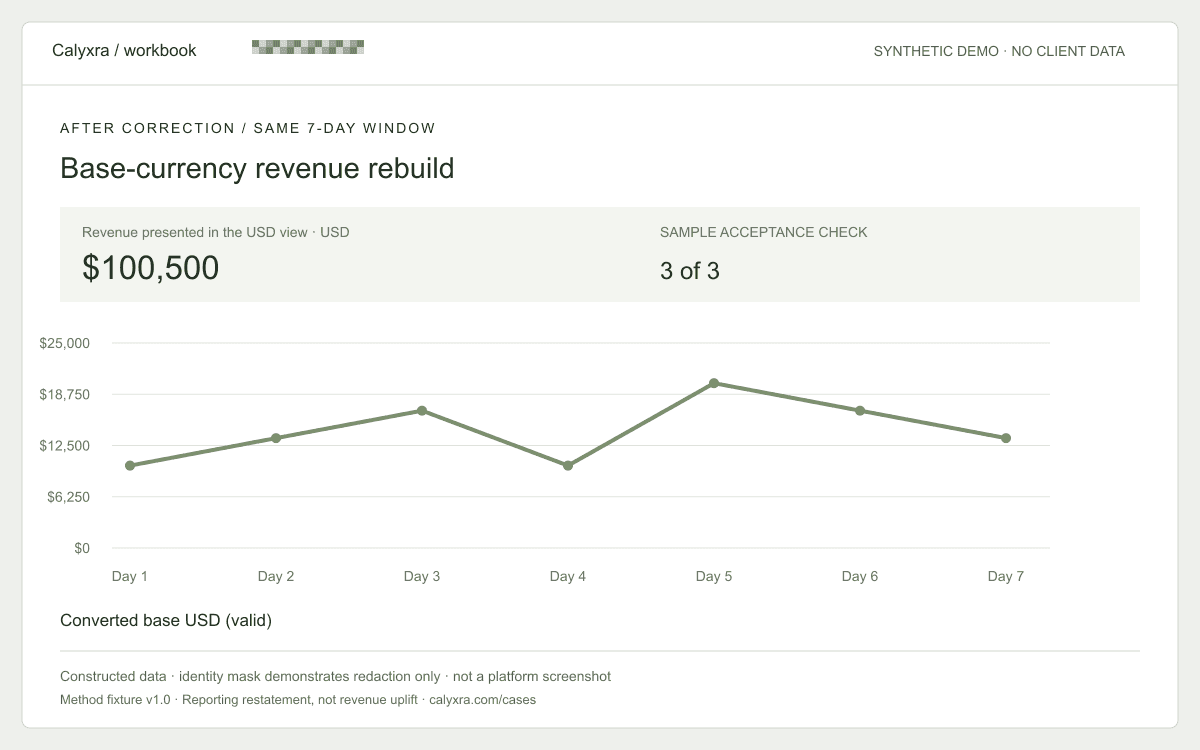
One conversionComparable base values

Symbolic values show unit lineage only. They are not exchange-rate, profit, or market-performance claims.

Cause isolated

Native amounts reached the reporting model without a reliable ISO currency or one approved conversion policy.

Bounded change

Preserve native amount and currency, derive the base value once, and block aggregation when unit lineage is missing.

Acceptance check

Test orders retain native and base values through every reporting layer with one explainable conversion.

Decision reopened

Compare markets on one governed contribution view before reallocating media or inventory.

What this does not prove

Currency reconciliation does not prove market incrementality, profitability, or the correct hedging policy. Tax, treasury, and ERP redesign remain outside this scope.

Technical evidence & acceptance criteriaOpen working file +

Systems in view

  • Shopify Markets orders
  • Payment settlement and payout exports
  • Meta and Google conversion payloads
  • Warehouse model and Finance rate table

Evidence reproduced

  • Market-launch timeline and supported currencies
  • Test orders in each active market
  • Raw amount and ISO currency payloads
  • Connector schema, FX source, timestamp, and dashboard logic

Acceptance criteria

  • ISO currency is present for every eligible monetary record.
  • Native values tie to the corresponding Shopify source records.
  • Each base value has one reproducible FX source, date, and calculation.
  • Mixed-currency fields cannot be aggregated without conversion.
  • Remaining settlement variance is tied to named timing or rate items.
Incident file / 05Composite company · not a client

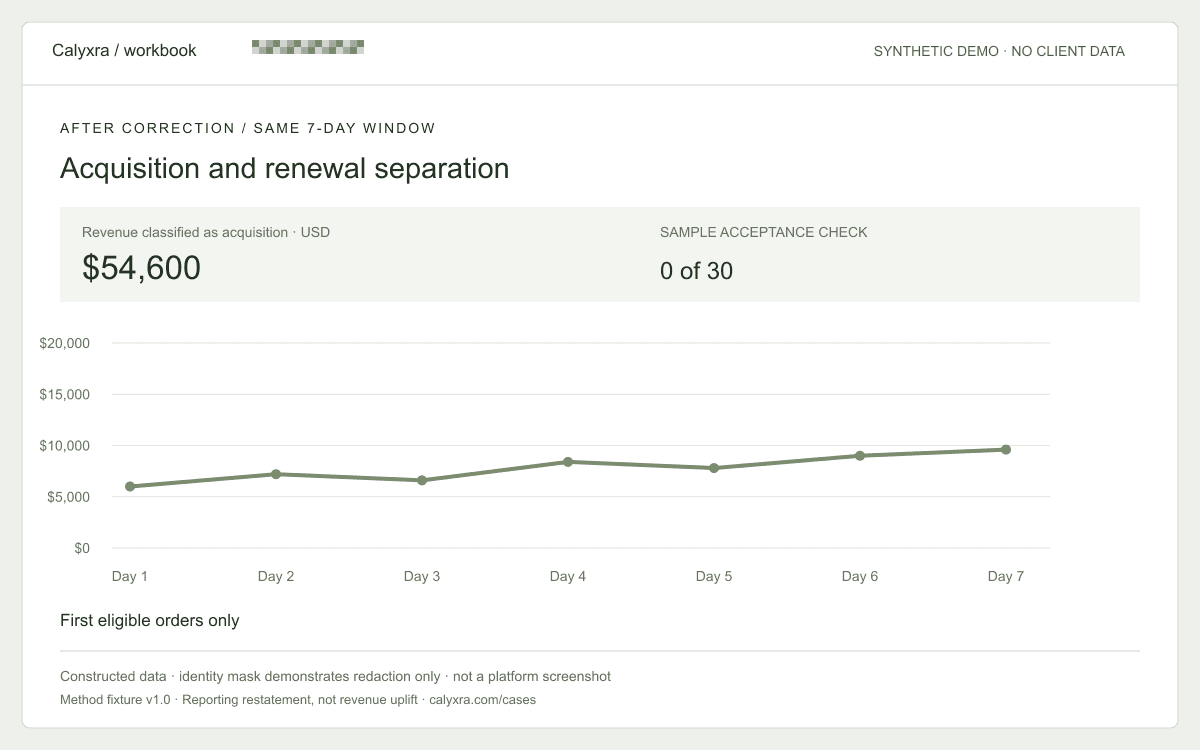
Paid-channel revenue rose while first orders did not. Existing renewals had entered the acquisition branch.

A subscription migration made renewals look like acquisition revenue.

Acceptance stateOne lifecycle state
Representative company profileConstructed for this worked example
BusinessSubscription wellness brand
Market / modelUnited States · DTC + subscription
Relevant stackShopify · Recharge / Skio · Klaviyo · warehouse
Decision ownerGrowth lead + Retention lead
Decision blocked

Did prospecting improve, or were renewals reassigned to paid acquisition?

Illustrative subscription event tapeOrder lifecycle

Before / lineage broken

Initial orderS-014
RenewalParent ?
RenewalParent ?
Fallback branchAll → acquisition

After / lineage restored

Initial orderS-014Acquisition
RenewalS-014Retention
Lifecycle rule1 order = 1 state

The taxonomy separates acquisition from retention; it does not prove advertising causality or forecast LTV.

Cause isolated

The migration replaced the stable subscription key, so renewals lost their parent lineage and defaulted to new acquisition.

Bounded change

Restore subscription lineage and route every eligible order through a mutually exclusive lifecycle taxonomy.

Acceptance check

Initial, renewal, reactivation, refund, and cancellation records tie to source and each order receives one state.

Decision reopened

Reset CAC, payback, and retention reporting before increasing prospecting spend.

What this does not prove

Lifecycle repair does not prove advertising caused the subscription or predict lifetime value. Broader identity and forecasting work remains separate.

Technical evidence & acceptance criteriaOpen working file +

Systems in view

  • Subscription platform records
  • Shopify Orders and Customers
  • Klaviyo lifecycle events
  • Warehouse transformation and acquisition dashboard

Evidence reproduced

  • Migration mapping and affected window
  • Subscription, charge, order, and customer keys
  • Initial, renewal, reactivation, refund, and cancellation samples
  • Order tags and downstream classification logic

Acceptance criteria

  • Parent subscription lineage persists through each eligible recurring order.
  • Lifecycle categories are exhaustive and mutually exclusive.
  • A pre-existing subscriber is never marked new solely because of migration.
  • Renewal totals reconcile to the subscription source.
  • The corrected dashboard runs in parallel without unexplained classification drift.

The useful file is the one happening inside your business now.

We will assess fit, required evidence, change boundaries, and the acceptance criteria that would make the issue closable. No performance outcome is promised.

Scope your incident