 Calyxra.
Should the team scale the new markets, or correct the currency path first?
Whether international media and inventory should increase after an apparently profitable launch.
Before / unit context lost
After / governed lineage
Symbolic values show unit lineage only. They are not exchange-rate, profit, or market-performance claims.
Native amounts reached the reporting model without a reliable ISO currency or one approved conversion policy.
Preserve native amount and currency, derive the base value once, and block aggregation when unit lineage is missing.
Test orders retain native and base values through every reporting layer with one explainable conversion.
Evidence package / 01–03
See what changed in the numbers.
These dashboard reconstructions use constructed data. The pixelated identity field demonstrates redaction; it does not conceal a real client. The daily chart values and example check results are available in the accompanying CSV.
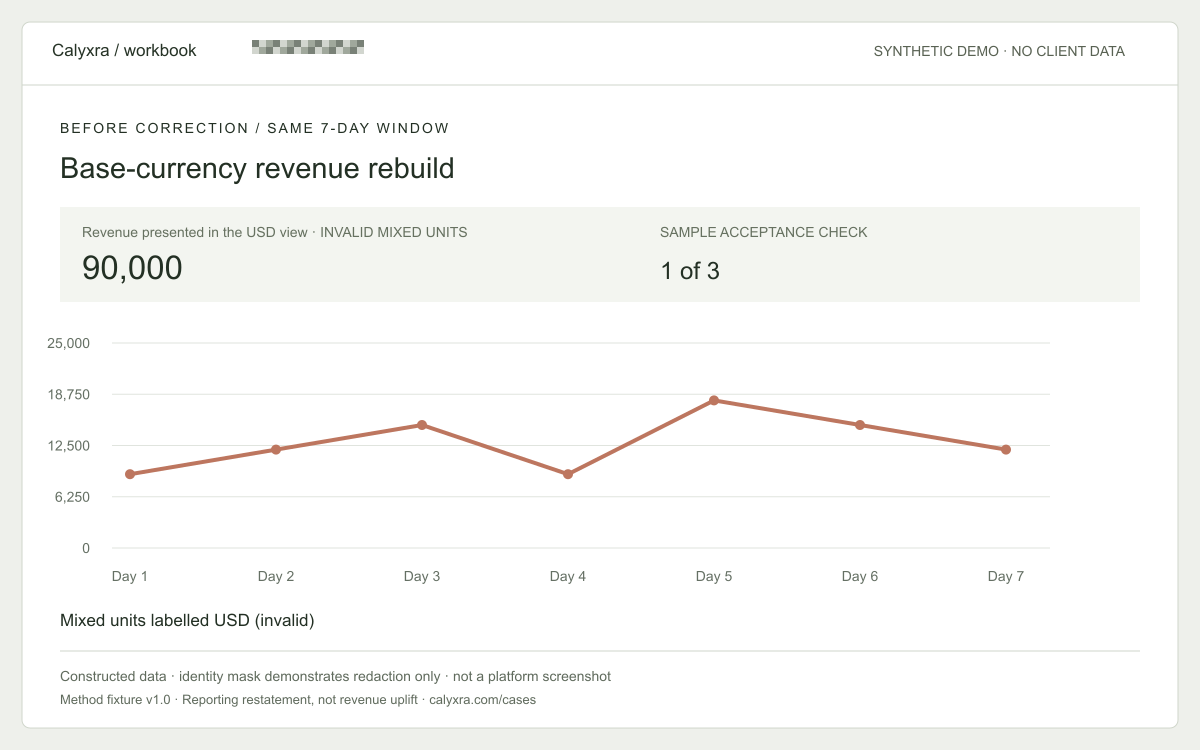
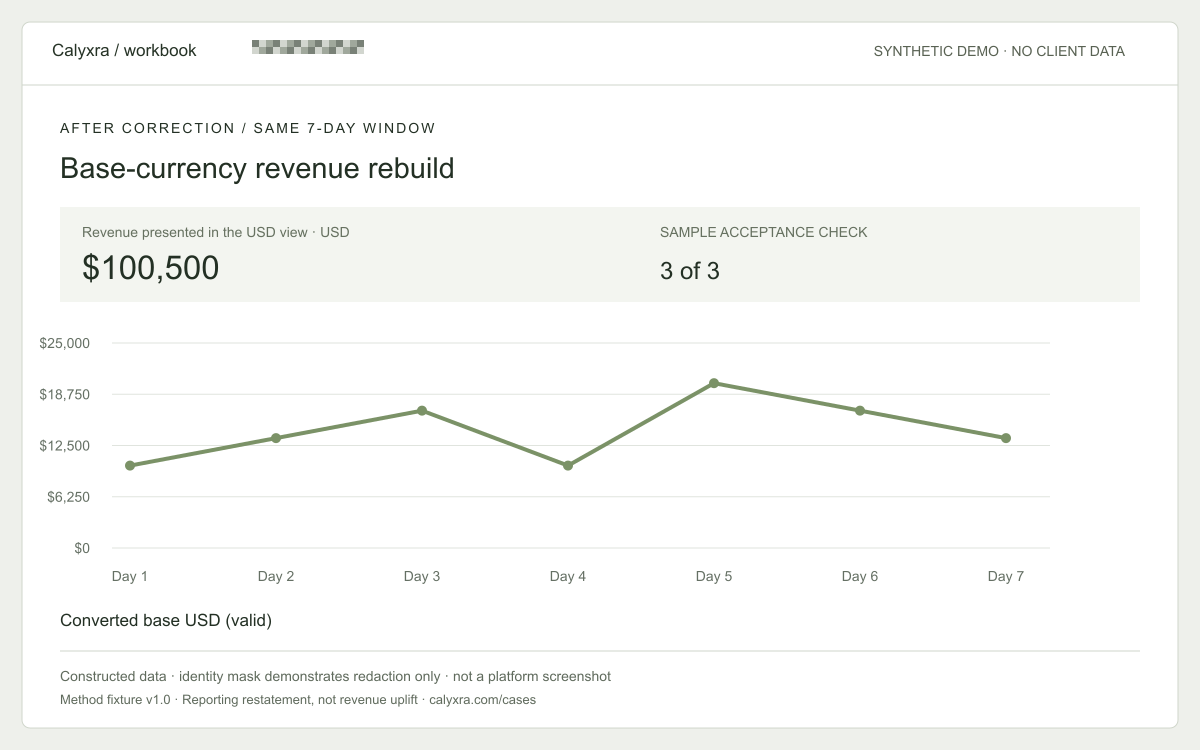
03 / Before & after reconciliation
Revenue presented in the USD view
This is a restatement of the same period, not a time-series experiment or a claim of revenue growth caused by Calyxra.
Before1 of 3
After3 of 3
The check results are separate constructed fixtures, not measurements inferred from the revenue chart or logs from a client engagement.
Inspect the seven-day dataset
| Day | Before correction | After correction |
|---|---|---|
| 1 | 9,000 (invalid mixed units) | $10,050 |
| 2 | 12,000 (invalid mixed units) | $13,400 |
| 3 | 15,000 (invalid mixed units) | $16,750 |
| 4 | 9,000 (invalid mixed units) | $10,050 |
| 5 | 18,000 (invalid mixed units) | $20,100 |
| 6 | 15,000 (invalid mixed units) | $16,750 |
| 7 | 12,000 (invalid mixed units) | $13,400 |
| Total | 90,000 (invalid mixed units) | $100,500 |
The working method
What gets checked, changed and handed back.
In this scenario, a connector preserved monetary amounts but not dependable currency lineage. GBP, EUR, and USD records therefore entered one decision model as directly comparable values.
Decision Risk Score methodologyEvidence required
- Market-launch timeline and supported currencies
- Test orders in each active market
- Raw amount and ISO currency payloads
- Connector schema, FX source, timestamp, and dashboard logic
Correction sequence
- Preserve native amount and ISO currency on every monetary record.
- Create a separate base amount using one approved FX source and date policy.
- Convert exactly once and expose missing or unsupported currency codes.
- Link refunds and fees to the originating order and market.
- Document the difference between operating and realised-settlement views.
Closure criteria
- ISO currency is present for every eligible monetary record.
- Native values tie to the corresponding Shopify source records.
- Each base value has one reproducible FX source, date, and calculation.
- Mixed-currency fields cannot be aggregated without conversion.
- Remaining settlement variance is tied to named timing or rate items.
Compare markets on one governed contribution view before reallocating media or inventory.
Currency reconciliation does not prove market incrementality, profitability, or the correct hedging policy. Tax, treasury, and ERP redesign remain outside this scope.
A similar issue?
Request a 2-day incident review.
A focused diagnostic: evidence map, initial findings, and a proposed fix scope. Two business days from agreed scope, payment where applicable, and complete required data. We confirm feasibility and fee before work starts. Implementation and longer verification windows are scoped separately.