 Calyxra.
Can the team trust new-customer CAC before moving more budget into prospecting?
Whether prospecting deserves more budget after the reported new-customer share rises abruptly.
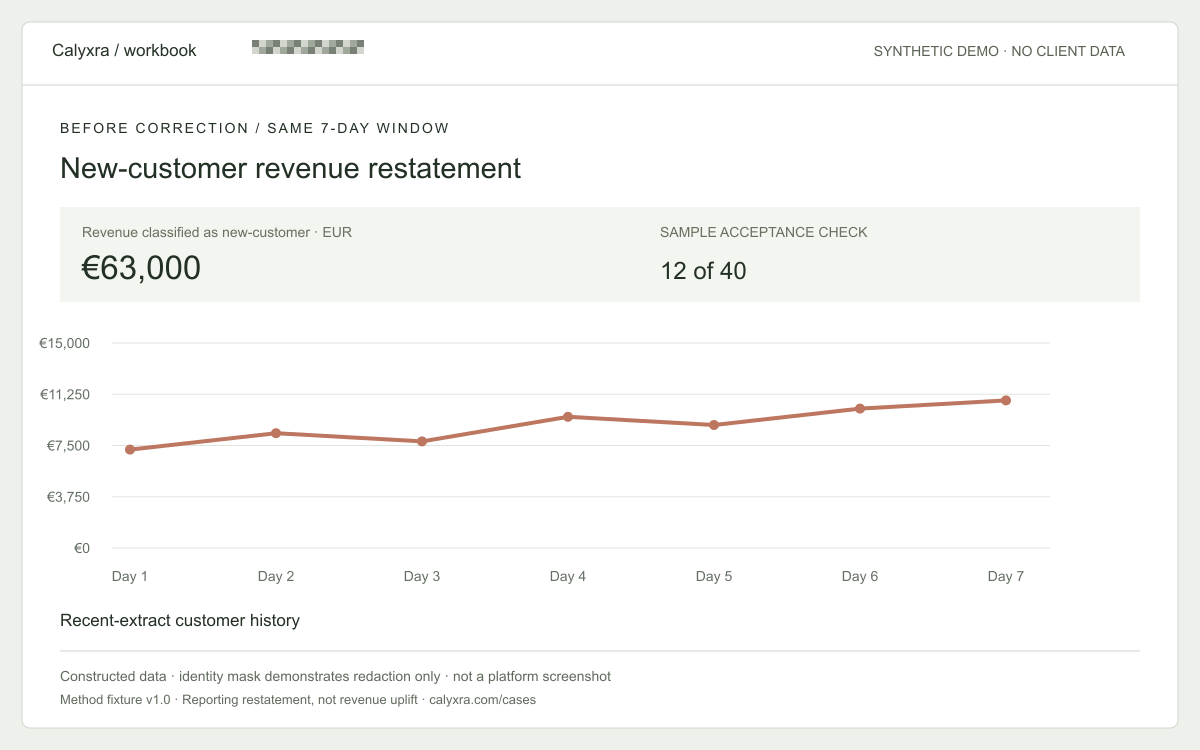
Before / recent extract only
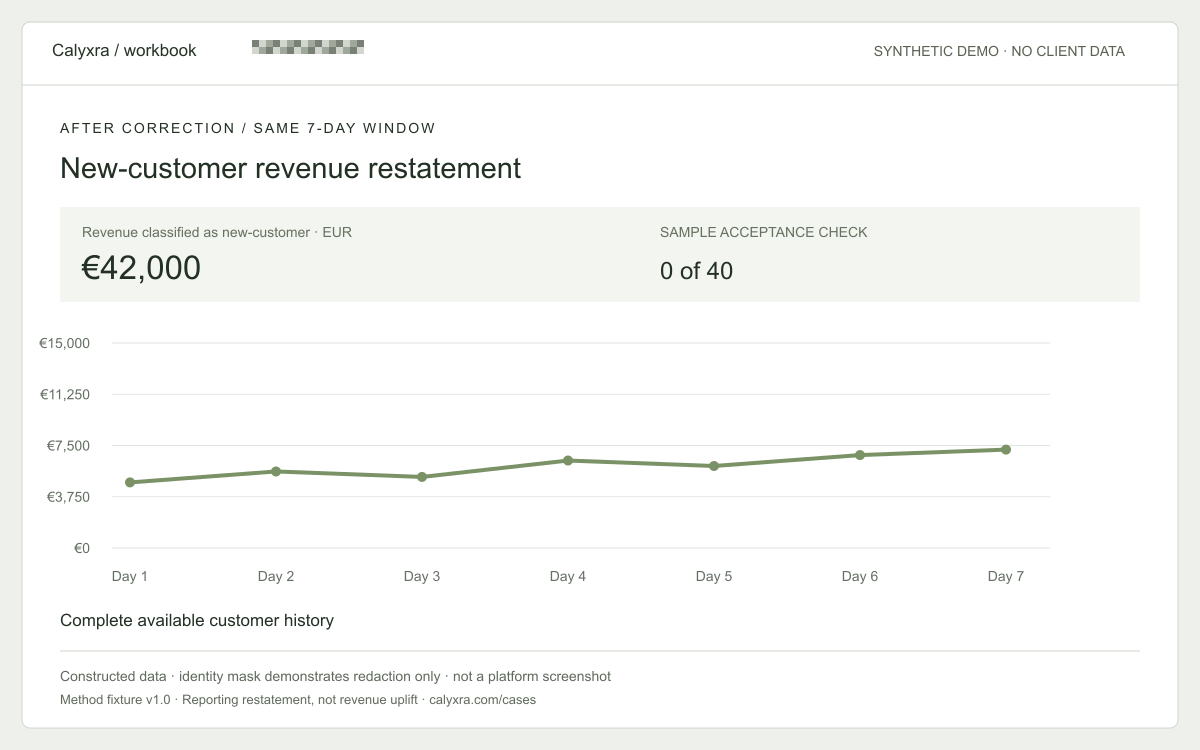
After / complete available history
The correction repairs the reporting definition; it does not build a household identity graph.
The migrated model searched only the recent extract, so buyers with older orders were incorrectly marked as new.
Rebuild first-order classification from the complete available history and version the customer definition.
No sampled customer remains ‘new’ when an earlier eligible order exists, and each order is classified once.
Evidence package / 01–03
See what changed in the numbers.
These dashboard reconstructions use constructed data. The pixelated identity field demonstrates redaction; it does not conceal a real client. The daily chart values and example check results are available in the accompanying CSV.
03 / Before & after reconciliation
Revenue classified as new-customer
This is a restatement of the same period, not a time-series experiment or a claim of revenue growth caused by Calyxra.
Before12 of 40
After0 of 40
The check results are separate constructed fixtures, not measurements inferred from the revenue chart or logs from a client engagement.
Inspect the seven-day dataset
| Day | Before correction | After correction |
|---|---|---|
| 1 | €7,200 | €4,800 |
| 2 | €8,400 | €5,600 |
| 3 | €7,800 | €5,200 |
| 4 | €9,600 | €6,400 |
| 5 | €9,000 | €6,000 |
| 6 | €10,200 | €6,800 |
| 7 | €10,800 | €7,200 |
| Total | €63,000 | €42,000 |
The working method
What gets checked, changed and handed back.
In this scenario, the migrated model searched for an earlier order only inside a recent extract. Customers whose first eligible purchase predated that extract were therefore classified as new.
Decision Risk Score methodologyEvidence required
- Extract boundaries and migration timeline
- Complete available paid-order history
- Current new-versus-returning logic
- Boundary cases, guest checkouts, and a stratified order sample
Correction sequence
- Define the first eligible order, excluding tests and other agreed non-commercial records.
- Rebuild first-order classification from the complete available Shopify history.
- Use Shopify customer ID as the primary identity key and document the guest-checkout fallback.
- Correct the affected transformation and its downstream dashboard.
- Version the definition in the metric contract.
Closure criteria
- No current-period customer is marked new when an earlier eligible order exists.
- Every current-period eligible order is classified exactly once.
- A stratified manual sample matches the agreed definition with no unexplained exceptions.
- Dashboard totals reconcile to the corrected classification table.
- Old and corrected logic run in parallel through the agreed verification window without regression.
Reset the new-customer CAC guardrail before allocating more prospecting budget.
This bounded correction does not build a household identity graph or prove the causal value of advertising. Broader identity engineering remains a separate scope.
A similar issue?
Request a 2-day incident review.
A focused diagnostic: evidence map, initial findings, and a proposed fix scope. Two business days from agreed scope, payment where applicable, and complete required data. We confirm feasibility and fee before work starts. Implementation and longer verification windows are scoped separately.